

At our lab
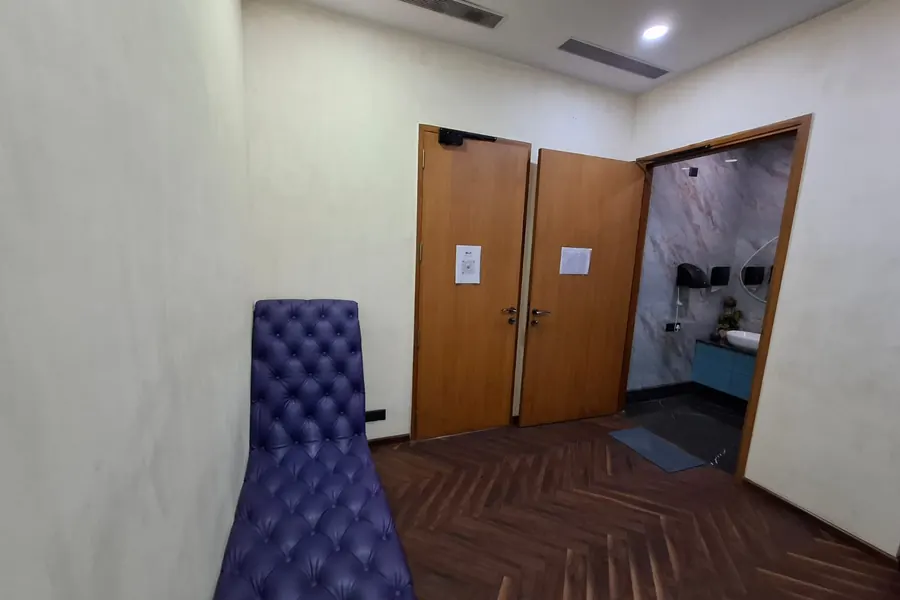
- Private, lockable room with attached washroom
- Labelled container provided. Leave it in the room; our staff take it to the lab.
- Analysis starts within 30 minutes of the sample liquefying
- No travel time for the sample
MALE FERTILITY TEST · GK-I, SOUTH DELHI
A sperm analysis test checks how many sperm you make, how well they move and how they're shaped. At Dr Bhasin's Lab in Greater Kailash-I, you give the sample in a private collection room, analysis starts within 30 minutes of the sample liquefying, and you get your report the same day.
Medically reviewed by Dr Vishu Bhasin, Consultant Pathologist and Director · Last reviewed: 25 November 2026
₹1,500
Also available under CGHS.
One sample, both tests
If your doctor has asked for both, see the DFI test.
WHY GIVE YOUR SAMPLE AT OUR LAB
We are the only independent pathology lab in Delhi with a dedicated private semen collection room, not a washroom, set up as WHO recommends, next to the lab. That matters for your result, not just your comfort. Semen begins to change soon after collection, and the World Health Organization recommends collecting in a private room close to the lab, so the sample isn't exposed to temperature swings or delay.

WHAT THE TEST MEASURES
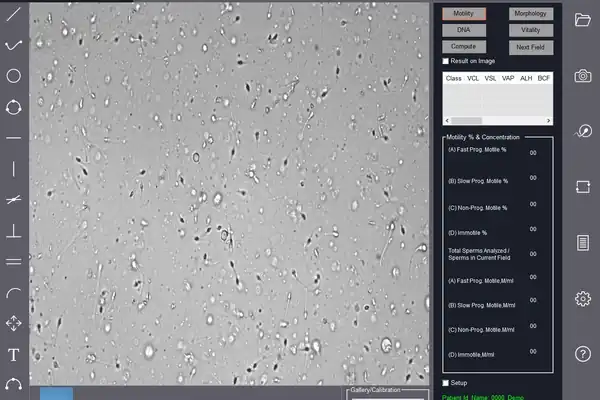
A semen analysis, also called a sperm count test, sperm test or semen routine examination, looks at both the fluid and the sperm in it: how much semen there is, how many sperm, how well they swim and what proportion are normally shaped. It's usually the first test doctors ask for when checking male fertility.
| What we measure | What it tells your doctor |
|---|---|
| Volume | How much fluid is produced. Very low volume can point to an incomplete collection or a blockage. |
| Sperm concentration and total count | How many sperm are in each millilitre and in the whole sample |
| Motility (movement) | What share of sperm swim forwards, move without going anywhere, or don't move |
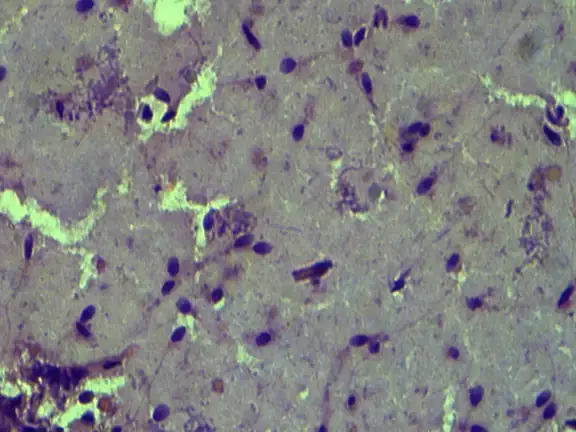
| Morphology (shape) | What share of sperm have a normal head, midpiece and tail under strict criteria |
| pH, liquefaction, viscosity | Whether the glands that make semen are working normally |
| Agglutination | Whether sperm are clumping together |
| Vitality (on request) | Whether non-moving sperm are alive. Your doctor can ask for this. |


WHEN TO TEST
Get a sperm analysis test when your doctor, IVF specialist or urologist asks for it, or, if you're trying for a baby, after 12 months without success (6 months if your partner is 35 or older). That timing is what the American Society for Reproductive Medicine recommends. Test sooner if you have a known risk factor.
Test both partners together. Male factors are found in about half of couples with infertility: on their own in about 1 in 5 couples, and alongside a female factor in many more. Worldwide, about 1 in 6 adults experience infertility at some point in their lives (WHO, 2023).
BEFORE YOUR TEST
Avoid ejaculation for 3 to 5 days before the test. Too short a gap lowers the count; too long can reduce how well sperm move.
GIVING YOUR SAMPLE
The most reliable way is to give your sample in our private collection room. If you'd rather collect at home, you can, as long as the sample reaches us within 50 minutes.
Collect by masturbation directly into the container, and note the time you collected it. If your doctor has also asked for a DFI test, the same sample can be used for both.
ACCURACY
Semen analysis is sensitive to how the sample is collected, how long it waits and how carefully it's counted. Small slips at any step can change your result, which is why we control each one.
| What can throw a result off | What we do about it |
|---|---|
| Part of the sample lost, or lubricant or saliva used | Clear instructions; you tell us if anything spilled, and we note it on the report |
| Delay, heat or cold before testing | Collection room next to the lab; outside samples only within 50 minutes |
| Testing before the sample has fully liquefied, or poor mixing | Analysis starts once the sample liquefies, within 30 minutes of that |
| Counting only a few sperm, or picking "easy" areas of the slide | Automated analysers count many more sperm than manual counting can, and manual microscopy is used when a sample needs a closer look |
| Judging movement and shape by eye alone | Automated analysis, with every report reviewed by a pathologist; a second analyser or manual microscopy is added when the sample needs it |
| Comparing tests taken under different conditions | Abstinence days, collection place and times printed on every report |
YOUR REPORT
Your report compares each result with reference values from the World Health Organization. Always read your result against the range printed on your own report, and discuss it with your doctor.
Our reports use the WHO 2021 reference values: the lower limits seen in men whose partners became pregnant within a year.
One abnormal report doesn't mean you're infertile. Sperm counts naturally vary from sample to sample, so guidelines advise repeating the test, usually about a month later, if the first result is abnormal. Likewise, a normal report doesn't rule out a male factor. It's one part of the picture.

| Measure | Lower reference limit |
|---|---|
| Semen volume | 1.4 mL |
| Sperm concentration | 16 million per mL |
| Total sperm count | 39 million per sample |
| Total motility | 42% |
| Progressive (forward) motility | 30% |
| Vitality | 54% live |
| Normal forms | 4% |
MYTHS AND FACTS
Infertility is usually the woman's problem.
Male factors are involved in about half of couples with infertility. Guidelines recommend testing both partners at the same time.
If I feel healthy, my sperm must be fine.
Most things that affect sperm cause no symptoms. A man can feel perfectly well and still have a low count or poor movement.
A semen analysis tells you whether you're fertile.
It's an important first test, not a fertility verdict. Fertility also depends on your partner's health, how well sperm function, and other factors a standard test doesn't measure.
One test tells the whole story.
Results vary from sample to sample, and sperm take about 2 to 2½ months to develop (roughly 64–74 days from start to full maturity). That's why an abnormal result is usually repeated.
Testing can wait until her tests are done.
Testing early, alongside your partner, saves months. A semen test is simple, painless and gives answers quickly.
AFTER THE TEST
If your semen analysis is abnormal, the usual next step is a repeat test, then a visit to a urologist, andrologist or fertility specialist, who may order further tests. Your partner's evaluation should carry on at the same time.
Further tests your doctor may suggest, depending on your result and history:
Low counts and poor movement often have causes that can be found, and some can be treated. That's a conversation for your doctor; this page doesn't replace medical advice.
DR BHASIN'S NOTE
Dr Vishu BhasinConsultant Pathologist and Director, Dr Bhasin's LabTrying for a baby and not succeeding is stressful enough. Being asked for a semen sample, in an unfamiliar place, on a schedule, adds a pressure that most men don't talk about. We understand that. So we built a private, lockable collection room next to our lab and made it as comfortable as we could, so you can take your time without feeling watched or rushed.
We also know this isn't a test anyone wants to repeat again and again, and that a lot rides on the result. That's why every sample is analysed with care and precision, using the technology it needs, and reviewed by a pathologist before the report reaches you.
AT OUR LAB
COMMON QUESTIONS
You collect a semen sample by masturbation into a sterile container, either in our private room or at home. The lab then measures volume, count, movement and shape. There's no needle and no pain.
A sperm analysis test (semen analysis) at Dr Bhasin's Lab costs ₹1,500. It's also available under CGHS.
3 to 5 days.
Yes. Use a sealed sterile container, keep it close to your body, and bring it to our GK-I lab within 50 minutes. We don't collect semen samples from home.
Our container, or any sealed, sterile, wide-mouth container from a chemist. Don't use a condom or any container that isn't sterile.
No. Leave the labelled container in the collection room; our staff collect it from there and take it to the lab.
Yes. If your doctor has asked for both, one sample is enough for the semen analysis and the DFI test.
WHO 2021 reference values put the lower limit at 16 million sperm per mL, or 39 million in the whole sample. Your report shows the reference range we use.
It means no sperm were seen in the sample. It has several possible causes, some treatable. Show your report to your doctor or a urologist; a repeat test is usually advised.
Not necessarily. Results vary between samples, so doctors usually repeat the test after about a month before drawing conclusions.
The same day, on WhatsApp, by email and through our website login.
Yes. We accept semen samples from 7 AM to 8:30 PM every day, including Sundays and public holidays.
Yes. The collection room and its washroom lock from inside, you never carry the sample through a waiting area, and your report is sent only to you.
Dr Vishu Bhasin
Consultant Pathologist and Director, Dr Bhasin's Lab
This information supports, but does not replace, consultation with a qualified doctor.
Dr Bhasin's Lab, S-35, Hansraj Gupta Road, Greater Kailash-I, New Delhi 110048
Nearest metro: Kailash Colony and Greater Kailash stations · Semen samples 7 AM – 8:30 PM daily
Private room, same-day report.
S-35, Greater Kailash-I, New Delhi · Semen samples 7 AM – 8:30 PM daily